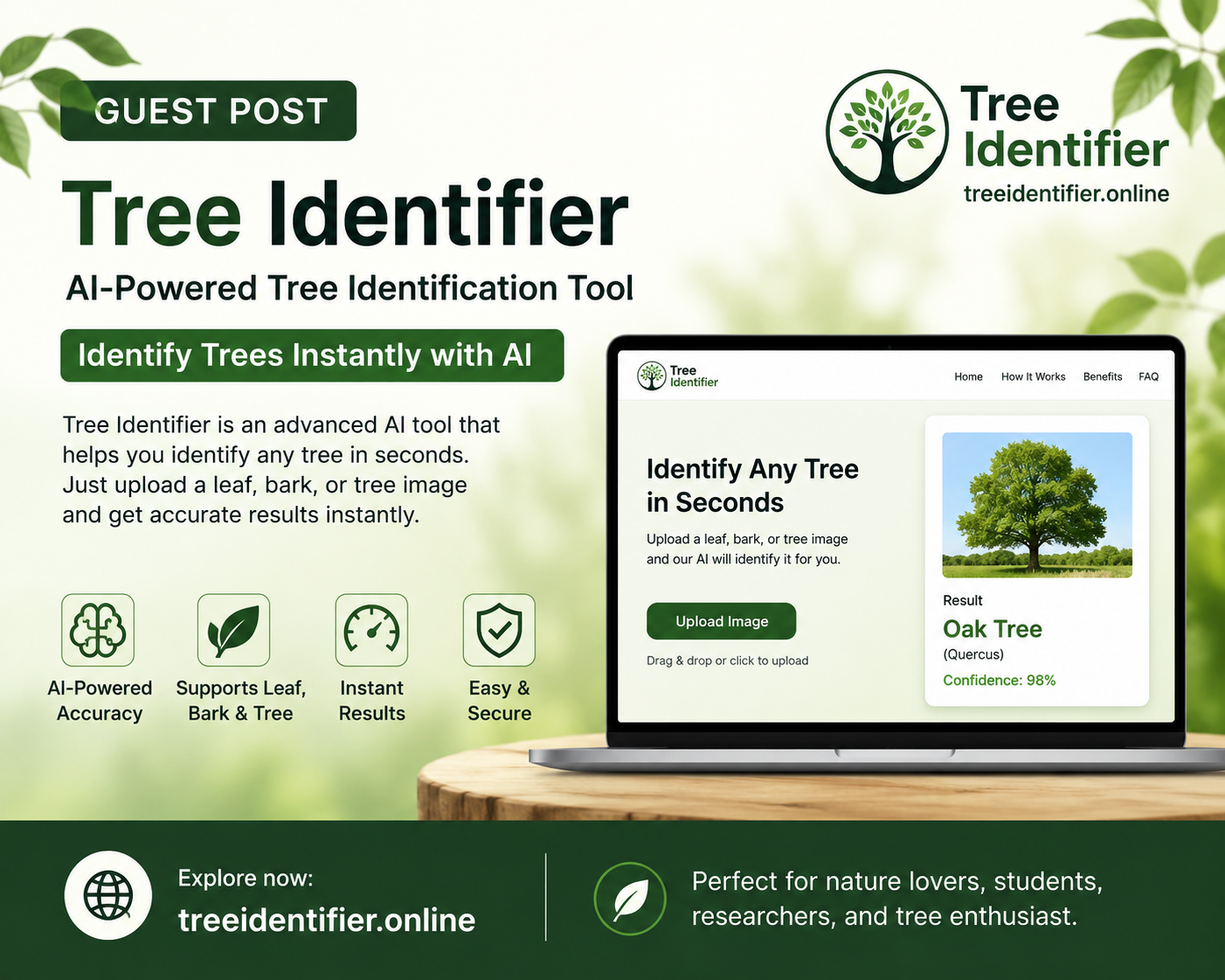
Tree Identifier: Discover Any Tree with AI-Powered Identification
Trees are all around us, yet identifying them can sometimes be surprisingly difficult. A tree may have distinctive leaves, unusual bark, colorful fruit, or a familiar shape, but recognizing its exact species often requires botanical knowledge and careful observation. Tree Identifier offers a simple solution by using artificial intelligence to analyze photographs and provide information about the tree you are looking at.
Tree Identifier is designed for nature lovers, students, gardeners, hikers, photographers, and anyone curious about the plants growing around them. According to the website, the tool can analyze images of trees, leaves, bark, fruit, flowers, and other identifying features, helping users discover species within seconds.
What Is Tree Identifier?
Tree Identifier is an online AI-powered tool created to make tree identification easier and more accessible. Instead of searching through numerous botanical books or comparing photographs manually, users can upload a picture and allow the AI system to analyze the visible characteristics.
The website states that its database covers more than 50,000 tree and plant species worldwide. It also provides information such as common and scientific names, plant families, native regions, typical height, and care recommendations.
This makes the platform useful not only for identifying an unfamiliar tree but also for learning more about the species after identification.
How Does AI Tree Identification Work?
Artificial intelligence can recognize visual patterns that may be difficult for an inexperienced observer to notice. Tree Identifier explains that its system examines characteristics such as leaf shape, vein patterns, bark texture, branching structure, fruit, flowers, and the overall silhouette of a tree.
The process is designed to be straightforward. Users first upload an image, the AI analyzes the visual information, and the tool then presents an identification result.
This approach can save time when you encounter an unfamiliar tree outdoors. Rather than trying to identify every feature yourself, you can use the image as a starting point and then research the suggested species in greater detail.
Identify Trees from Leaves
Leaves are among the most useful features for identifying trees because their shapes and arrangements often differ between species. A leaf may be lobed, smooth-edged, serrated, compound, glossy, hairy, or deeply divided.
Tree Identifier includes a dedicated leaf identification feature that focuses on these characteristics. The website explains that the tool considers factors such as leaf shape, arrangement, texture, and venation patterns.
For the best results, users should take a clear photograph of the leaf. A flat leaf photographed from directly above can make its outline and vein structure easier for an identification system to analyze.
Identify Trees by Bark
Leaves are not always available. During winter, after leaves have fallen, or when you are examining an evergreen or mature tree, bark can provide valuable clues.
Bark differs considerably among tree species. It may be smooth, rough, flaky, deeply ridged, peeling, or covered with distinctive patterns. Tree Identifier allows users to submit bark photographs as another method of identification.
For a better image, photograph a clear section of bark at eye level without excessive shadows. A close, focused photograph can give the AI more visual information to work with.
Identify Trees from the Whole Tree
Sometimes you may not have access to an individual leaf or piece of bark. In that situation, a photograph of the entire tree can still provide useful information.
The shape of a tree’s canopy, the arrangement of its branches, its height, and its overall growth pattern can help distinguish one species from another. Tree Identifier says that its system can analyze the full-tree silhouette in addition to individual botanical features.
When photographing an entire tree, step far enough away to include the canopy and major branches. Avoid taking the photograph from a position where buildings, vehicles, or other trees completely obscure the subject.
Why Accurate Tree Identification Matters
Knowing the identity of a tree is more than an interesting nature activity. Correct identification can be useful for gardening, landscaping, environmental education, conservation, and general outdoor awareness.
Different species have different water, sunlight, soil, pruning, and maintenance requirements. If a homeowner knows what type of tree is growing in a yard, they can research appropriate care practices rather than treating every tree in the same way.
Identification can also help people understand local ecosystems. Learning which species are native, introduced, ornamental, or potentially invasive can provide a better understanding of the environment.
Tree Identifier also points out that some plants can have toxic fruits, sap, or other potentially hazardous characteristics, making careful identification particularly important before interacting with an unfamiliar plant.
Useful for Students and Nature Enthusiasts
Students studying biology, botany, environmental science, or ecology can use AI identification as a convenient learning aid. Instead of simply memorizing names, students can photograph trees around their school, home, or local parks and investigate the characteristics of each species.
Nature enthusiasts can use the same approach during walks and hikes. A tree that previously looked like an ordinary part of the landscape can become an opportunity to learn about native habitats, wildlife relationships, and plant diversity.
For photographers, identification can also add context to nature photography. Knowing the scientific name of a photographed tree can make it easier to research its natural range, seasonal changes, and ecological importance.
Tree Species Covered by the Tool
Tree Identifier says its database includes species from North America, Europe, Asia, Africa, Australia, and South America. The website highlights groups such as oak, maple, elm, pine, spruce, fir, birch, beech, cedar, willow, palm, eucalyptus, and magnolia. It also includes fruit trees such as apple, pear, cherry, peach, and walnut.
The platform also provides specialized identification pages for several popular groups, including oak, maple, pine, palm, birch, and elm trees.
This broad coverage can be especially useful for people who encounter trees from different regions or want to identify ornamental species planted outside their natural range.
How to Take Better Photos for Identification
The quality of the photograph can influence how useful an AI identification result is. A blurry, dark, or poorly framed image gives the system less information to analyze.
For leaves, use natural daylight whenever possible. Place a detached leaf on a plain background and photograph it from above. This makes the overall shape, edges, and veins easier to see.
For bark, move close enough to capture its texture without losing focus. For fruit or flowers, photograph the individual feature clearly while also considering whether an additional photograph of the surrounding branches would provide context.
For a complete tree, include the overall canopy and branching pattern. Tree Identifier recommends clear images with enough detail for its system to recognize visual characteristics.
A Simple Three-Step Identification Process
One of the main advantages of an online identification tool is simplicity. Tree Identifier describes its process in three basic steps: upload a photograph, allow the AI to analyze the image, and review the identification results.
The process does not require users to understand complicated botanical terminology before they begin. You can start with a photograph and use the resulting information to learn the terminology afterward.
For beginners, this can turn tree identification into a practical learning experience rather than a difficult research task.
What Information Can You Learn?
Identification is only the beginning. Once a tree has been recognized, additional information can help you understand what makes that species special.
Tree Identifier says its results can include the species name, scientific classification, family, habitat information, care tips, and ecological significance.
Scientific names are particularly useful because common names can vary between countries and regions. A scientific name provides a more precise reference for further research.
You can use the information to learn about the tree’s native habitat, expected size, growth characteristics, seasonal appearance, and role in the ecosystem.
Is AI Tree Identification Always Perfect?
AI identification can be extremely convenient, but users should still treat automated results as a helpful starting point rather than unquestionable scientific proof.
Tree Identifier states that it achieves more than 97% accuracy for common tree species while noting that results can vary for rare or regional species. The site recommends cross-referencing results with local botanical guides for scientific purposes.
This is an important consideration. Some species look remarkably similar, and a single photograph may not contain enough information to distinguish between closely related trees.
If an identification has important consequences—such as determining whether a plant is safe to consume, making a conservation decision, or diagnosing a serious tree problem—it is sensible to verify the result with a qualified botanist, arborist, or reliable regional reference.
Privacy and Ease of Access
Tree Identifier presents itself as a browser-based service, meaning users do not need to download a dedicated application to use the identification tools. The website says the service works on mobile devices, tablets, and desktop computers.
The site also states that uploaded photographs are processed securely and are not stored on its servers. Users who are concerned about image privacy should nevertheless review the site’s current privacy policy before uploading photographs containing sensitive information.
Why Try Tree Identifier?
The biggest advantage of Tree Identifier is convenience. Identifying a tree traditionally involves collecting visual clues, consulting identification books, comparing photographs, and sometimes asking an expert. An AI-powered tool can make the initial process much faster.
It is also approachable for beginners. You do not need to know the difference between pinnate and palmate venation before starting. You can simply photograph a tree and use the result as an introduction to botanical identification.
The website states that its basic identification service is free and does not require registration or a subscription.
Final Thoughts
Tree identification is a fascinating way to become more aware of the natural world. Every tree has characteristics that can reveal its species, origin, habitat, and ecological role. With modern AI tools, discovering those characteristics can be easier than ever.
Tree Identifier brings together image analysis and botanical information in a simple online experience. Whether you are a student completing a nature project, a gardener trying to identify a tree in your yard, a hiker exploring a new area, or simply someone who wants to know the name of a tree, the tool provides a convenient place to begin.
For the most useful results, take clear photographs in good lighting, capture distinctive features such as leaves or bark, and verify uncertain identifications with trusted botanical resources. Used this way, AI does more than provide a name—it can encourage people to observe, research, and appreciate the trees that surround them.